 Indicator 1
Rejection of the democratic rules of the game |
Score 2 of 3
-
The losing side, not the winner. Allende
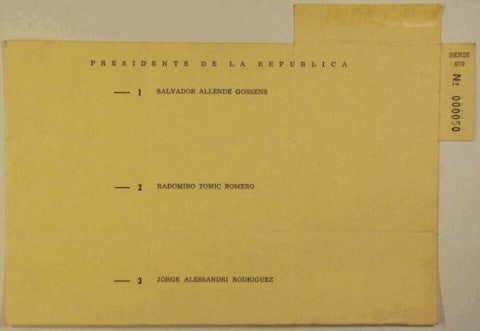
comes first on 4 September 1970 with 36.6 percent and no
majority, so the choice passes to Congress. General René
Schneider, who held that the army's job was to accept
whatever Congress decided, is shot in a kidnap attempt on
22 October and dies on 25 October
-
Nixon had ordered the CIA on 15 September to keep Allende
out of office. The agency was backing officers plotting a
coup and had withdrawn from General Viaux's group days
before his men shot Schneider
-
The legal version of the same plan: have Congress elect
Alessandri, who would then resign, forcing an election that
Frei could contest. Congress instead elects Allende on
24 October by 153 votes to 35, after he agrees to a Statute
of Constitutional Guarantees demanded by the Christian
Democrats as their price and drafted by a joint commission
of both sides
|
Score 1 of 3
-
The largest thing the government does all year is done by
the book: the copper mines are nationalised by
constitutional amendment, approved by Congress on 11 July
1971 with nobody voting against
-
The rest goes round Congress. Firms are
requisitioned or put under state administration using a
decree law of 1932, and when the Comptroller General refuses
to register a decree, the president and every minister sign
an insistence decree that overrides him
-
Popular Unity takes 49.7 percent at the municipal elections
in April, its best result, and treats it as a mandate for a
programme it cannot get through the chambers
|
Score 2 of 3
-
The constitution stops having an agreed meaning.
Congress passes a reform to halt the takeovers, Allende
vetoes most of it on 6 April 1972, and the two sides then
disagree for more than a year over whether Congress needs
two thirds or a simple majority to beat his veto. There is
no arbiter both accept
-
From 1973 he says he will settle it with a plebiscite and
never calls one. The thirty day window article 109 allows
runs out on 6 June 1973, and in May 1973 he asks the
Constitutional Tribunal instead
-
The opposition has been accusing his ministers before the
constitution since January 1971 and now succeeds for the
first time. The interior minister José Tohá is moved to
defence on 7 January 1972, the day after the Chamber lets
the accusation through, and the Senate removes him from
Interior on 22 January anyway
|
Score 2 of 3
-
Both sides go outside the chamber. The
lorry owners stop the country in the second week of October
and the professional associations join them. On 22 October
they publish El pliego de Chile, a list of demands issued by
bodies that had won no election, whose central demand is
that the government obey Congress and the courts
-
Allende declares a state of emergency province by province
and answers with the army. On 2 November the commander in
chief of the army, Carlos Prats, becomes interior minister,
with a rear admiral at public works and transport and an air
force general at mining
-
The strike ends on 5 November. A dispute between civilians
has been settled by putting the army's commander in chief,
and two officers under the other two service chiefs, in the
cabinet
|
Score 2 of 3
-
The one column where the votes work. The
congressional election of 4 March 1973 is held, counted and
accepted by both sides at the time. Popular Unity takes
about 44 percent of the vote for the Chamber, more than
Allende won in 1970, though almost exactly what the same
parties had won in the congressional election of 1969
-
The opposition takes 55.6 percent of the valid votes and misses the two
thirds of the Senate it would have needed to remove the
president. Both sides had treated the vote as the way out of
the deadlock, and neither gets what it came for
-
The constitutional fight runs on underneath it. In April the
Chamber rejects his vetoes to the Hamilton Fuentealba reform
on the three areas of the economy by simple majority. He
will not promulgate it and will not call the plebiscite
article 109 allows, holding that two thirds is required, and
in May he takes the quorum question to the Constitutional
Tribunal. It is still unresolved on 11 September
-
The next presidential election is not due until 1976
|
Score 3 of 3
-
On 29 June an armoured regiment drives on the
palace. Sixteen armoured vehicles, among them M41
tanks, and about eighty soldiers under Lieutenant Colonel
Roberto Souper attack La Moneda and the defence ministry.
About twenty two people are killed. General Prats puts the
rising down in person
-
Allende asks Congress the same day, 29 June, for a state of
siege, and the Senate rejects the bill in special session on
3 July
-
On 26 May the President of the Supreme Court had already
sent him an oficio transcribing an agreement of the full
court, saying the country was heading for a breakdown of the
rule of law because his government was not enforcing its
judgments
|
Score 3 of 3
-
On 22 August the Chamber of Deputies votes 81 to 47
for a resolution declaring a grave breakdown of the
constitutional and legal order, addressed to the president
and to the ministers drawn from the armed forces and
Carabineros, and telling those ministers that ending it is
what would make their presence in the cabinet worth anything
to the republic
-
The day after the vote, on 23 August, Prats resigns the
ministry of defence and the command of the army, and
recommends his own successor. Allende appoints Augusto
Pinochet
-
It is not an impeachment and it removes nobody. Allende
answers on 24 August that the only way Congress may judge
him is a constitutional accusation, that the opposition
failed in March to win the Senate votes for one, and that
the Chamber is asking soldiers to become deliberative and
break their duty of obedience to the government, which he
calls promoting a coup
|
Score 3 of 3
-
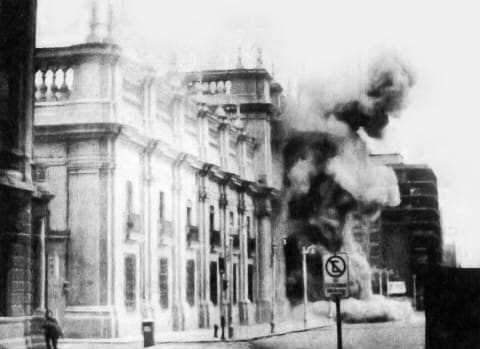
11 September 1973. The navy takes
Valparaíso at dawn, the armed forces broadcast a joint
ultimatum, air force jets bomb La Moneda, and the president
dies inside it
-
Congress is closed by Bando 29 on 14 September and formally
dissolved by Decree Law 27, dated 21 September and published
on the 24th. The Constitutional Tribunal is abolished by
Decree Law 119 of 5 November, published on the 10th, on the
ground that with Congress gone it is unnecessary
-
The junta's own first decree, of 11 September, promises to
respect the constitution and the laws of the republic to the
extent that the present situation of the country permits
|
 Indicator 2
Denial of the legitimacy of political opponents |
Score 2 of 3
-
The winner is treated as illegitimate before he
takes office. On 15 September Nixon tells the
director of the CIA to make the Chilean economy scream. The
notes of that meeting record ten million dollars available
and more if needed
-
The seven weeks between the vote and the congressional
session are spent trying to stop the result taking effect,
by an argument that 36.6 percent is not a mandate
-
Against that, the price Allende pays is an explicit promise
of the other side's rights: party pluralism, freedom of
information, freedom of education and university autonomy,
written into the constitution as Law 17,398 on 9 January 1971
|
Score 1 of 3
-
The land is taken faster than the law hands it
over, and not to anyone's plan. In Cautín province
alone one study counts 221 farm occupations between October
1970 and the end of 1971, only a third of them organised by
revolutionary groups and two fifths with no party or union
behind them at all
-
Fidel Castro spends most of November touring the country as
the government's guest, which the opposition reads as a
statement of intent
-
The parties still argue with each other in Congress, and the
copper amendment passes without a vote against, so this is
not yet a cell about enemies
|
Score 2 of 3
-
The argument stops being about policy and becomes
about whether the government is lawful at all. The
decrees are renamed resquicios legales, legal loopholes. The
government's own paper La Nación uses the phrase in an
editorial on 21 February 1972, El Mercurio takes it up in
August and never gives it back
-
Ministers become the target instead of bills. Over the
government's three years at least ten of them are accused
before the constitution and seven are removed
-
On the other flank, groups inside and outside the coalition
argue openly that the road through Congress is finished
|
Score 2 of 3
-
El pliego de Chile, 22 October 1972. The
trade and professional associations present their demands as
the demands of the country, and El Mercurio prints them
-
The government calls the stoppage sedition, and the strikers
call the government unlawful: on 25 October the opposition
majority in the Chamber signs a text declaring it illegal.
Neither description leaves room for the other side to win an
election
|
Score 2 of 3
-
The election is fought over whether the government
should exist. The opposition runs as one bloc with
the stated aim of the two thirds of the Senate that would
let it remove the president
-
It does not get them. Allende says so himself in August: the
opposition tried in March to win the votes for a
constitutional accusation and failed
|
Score 2 of 3
-
The Supreme Court tells him in writing that his
administration is acting unlawfully. Its oficio of
26 May 1973, transcribing an agreement of the full court,
says the acts of the political authority are producing a
crisis of the rule of law and an imminent breakdown of the
legal order. Allende answers the President of the Court in
writing on 12 June
-
After the failed rising of 29 June the government's
supporters occupy more than 350 factories, and the armed
forces take it that the cordones are arming themselves with
the government's tolerance
|
Score 3 of 3
-
The 22 August resolution says the government is
trying to conquer total power and install a
totalitarian system, and it is passed by a chamber the same
voters elected in March
-
The navy asks the courts to lift the parliamentary immunity
of the Socialist Party's leader, Carlos Altamirano, and of
the MAPU deputy Óscar Guillermo Garretón, for sedition among
sailors. The hearing is listed in Valparaíso for
11 September
|
Score 3 of 3
-
Decree Law 77, of 8 October, declares the
Communist, Socialist, Radical, MAPU, Christian Left and
Independent Popular Action parties unlawful associations,
along with the Unión Socialista Popular and any body holding
Marxist doctrine, and takes their property. Decree Law 78, a
week later, puts the remaining parties into recess,
including the Christian Democrats who had voted for the
22 August resolution
-
On 30 October the junta presents a Libro Blanco setting out
Plan Z, an alleged plot by the left to murder the officer
corps, as the reason for the coup. It was later described as
a psychological warfare operation, including by the junta's
own first press secretary
|
 Indicator 3
Toleration or encouragement of violence |
Score 2 of 3
-
The commander in chief of the army is killed for
refusing to intervene. Schneider is shot on
22 October 1970 and dies on 25 October
-
The army as an institution does not follow the plotters, and
the courts try them. Viaux is sentenced to twenty years in
June 1972, reduced to two that December on appeal by the
military court
|
Score 2 of 3
-
A far left group machine guns a former interior
minister in the street. Edmundo Pérez Zujovic is
killed on 8 June 1971 by the VOP. Eight days later one of
the killers shoots three officers dead at the headquarters
of the detective police and blows himself up with dynamite.
The government hunts the group down and destroys it
-
Patria y Libertad, formed the previous September to stop
Congress electing Allende, is refounded as a standing
nationalist front on 1 April 1971 and organises for force
from the start
-
The march of the empty pots on 1 December ends in street
fighting. A state of emergency is declared in Santiago
province and the officer commanding the garrison, Augusto
Pinochet, bans demonstrations
|
Score 2 of 3
-
Both sides start organising outside the
state. Workers build the first cordón industrial,
Cerrillos Maipú, on 19 June 1972 after the Perlak cannery is
taken over, and the rest of Santiago's cordones follow in
October; the nationalist right builds a paramilitary front.
Neither is a party and neither answers to one
-
Farm and factory occupations carry on through the year, and
the police lists of them become the opposition's evidence
|
Score 2 of 3
-
The country is stopped by blocking it. Main
roads are cut for most of a month, food and fuel barely
move, and shortages that were already bad get much worse
-
The government answers by requisitioning lorries, and
workers answer by taking over plants their employers have
shut and asking the state to take them on, which is the
mechanism the whole quarrel was about
|
Score 2 of 3
-
The copper mine strikes against the government that
nationalised it. Four of the five white collar
unions at El Teniente and one of the four workers' unions
stop on 18 April 1973, about 13,000 join within a week, and
they stay out for 76 days, led by a Christian Democrat union
leader
-
In May the government decrees a state of emergency in
O'Higgins on the 10th and Carabineros clash with the
strikers' supporters in Rancagua on the 25th. The miners'
march reaches Santiago in June
-
José Ricardo Ahumada Vásquez, a sewer worker and communist,
is shot dead on 27 April at a trade union march on the
Alameda
|
Score 3 of 3
-
Soldiers fire on the presidential palace for
hours. About twenty two people are killed in the
rising of 29 June, among them the Argentine cameraman
Leonardo Henrichsen, who filmed the soldier who shot him
-
Patria y Libertad fighters take part, and its leaders take
refuge in the Ecuadorean embassy afterwards
-
Luis Bravo Meneses, an El Teniente worker, is shot dead by
troops in Rancagua on 30 May when his car fails to stop
|
Score 3 of 3
-
The president's naval aide is shot at his own
house. Captain Arturo Araya is shot in the early
hours of 27 July 1973. A Patria y Libertad militant was
convicted of firing the shot in 1980 and pardoned the
following year
-
The lorry owners begin a second indefinite strike on
26 July and are still out on 11 September
-
Patria y Libertad blows up a bridge at the entrance to
Concepción on 23 August and attacks railway lines and
electrical installations on 25 August, then stops on
27 August to wait for the coup
-
Under the Arms Control Act that Congress passed in October
1972, the armed forces search factories and workplaces for
weapons through the winter
|
Score 3 of 3
-
The National Stadium becomes a prison camp
from 12 September to 9 November 1973. The Red Cross counted
about 7,000 people held there on 22 September, with two to
three hundred foreigners among them
-
The commission that counted the dead after the dictatorship,
chaired by Raúl Rettig, documented 2,279 people killed for
political reasons across the sixteen and a half years that
followed, from 11 September 1973 to 11 March 1990
|
 Indicator 4
Readiness to curtail civil liberties and the press |
Score 0 of 3
-
The price of the presidency is a guarantee of the
things a government could take away. The Statute of
Constitutional Guarantees writes party pluralism, freedom of
information, freedom of education and university autonomy
into the constitution, and he signs it to get the votes
-
Nothing is closed and nothing is censored in these months.
This cell is cream and it should be
-
The money already moving is foreign: American covert funding
of Chilean newspapers had been running for years before the
1970 vote
|
Score 1 of 3
-
The state moves into publishing. The
purchase of the Zig-Zag printing house is signed on
12 February 1971 and the state publisher Quimantú is created
in the same operation and starts printing that year. It
tries and fails to take the newsprint monopoly as well: the
bill for a state paper institute is thrown out in May 1971
and La Papelera's shareholders refuse to sell a share. State
advertising it does control, and the opposition press says
it is being squeezed out
-
The other side answers with money. The 40 Committee in
Washington deadlocks on 9 September 1971 over a request for
a million dollars, and Nixon personally approves 700,000
dollars for El Mercurio four days later, on condition it run
a campaign on press freedom
|
Score 1 of 3
-
Another 965,000 dollars for El Mercurio is approved
on 11 April 1972. The largest opposition newspaper
in the country is being kept open by a foreign government,
and it goes on printing every day
-
Through 1972 and 1973 the government's weapon is the courts:
it sues newspapers, magazines and radio stations under the
internal security law, and the courts sometimes grant the
suspension, so the padlock comes through them rather than
instead of them
|
Score 2 of 3
-
Every radio station in the country, and television
with them, is put into a compulsory national chain
by government decree under the state of emergency, the
broadcast produced by the state information office and
enforced by the military zone commanders. From 12 October
they carry it from 07.30 to 23.30, and from 15 October
nothing else at all. The strikers list it among their
grievances on 22 October
-
The opposition parties answer with a day of silence, a total
stoppage of activity, on 24 October, and the stations answer
by unhooking from the chain and being closed for it
|
Score 1 of 3
-
The plan for a unified national school is
shelved. Published in the Revista de Educación in
February 1973 and released publicly in March, it is read by
the bishops and by officers as a scheme to teach one
ideology. The plenary assembly of the bishops, meeting at
Punta de Tralca, rejects it again on 11 April, the same day
about 150 officers tell the education minister to his face
that they are against it, and he writes to Cardinal Silva
Henríquez the next day accepting a postponement. It is never
revived
-
The campaign of March 1973 is run against a hostile press
that nobody stops
|
Score 2 of 3
-
Radio Agricultura is ordered off the air for six
days on 30 May 1973 over its reporting of a death
at El Teniente. It defies the order and keeps broadcasting
on emergency equipment, a court orders the service restored,
and it is back to normal on 5 June. It is the fourth time
the government has suspended that station
-
Nothing is shut for good on either side. The opposition
papers and radios are still working in June
|
Score 2 of 3
-
Attacks on freedom of expression are among the
charges in the resolution of 22 August. The Chamber
is describing real suspensions and real pressure, and its
remedy is to ask soldiers to fix them
-
On the morning of 11 September the whole press is still
printing, El Mercurio and the Communist El Siglo alike
|
Score 3 of 3
-
Books are burned in the street. Photographs
of soldiers burning left wing literature date from the end
of September 1973. A curfew and prior censorship are
imposed, the whole press is suspended, and only El Mercurio
and La Tercera are let back. The press of the left never
returns
-
El Mercurio, kept alive with American money since September
1971 in order to oppose the government, goes on publishing
|
 Indicator 5
Who could still hold the government to account
Added, not from the book |
Score 0 of 3
-
He is president because 153 members of Congress
voted for him, and he got those votes only by
agreeing to a constitutional amendment first
-
An opposition majority in both chambers, a Comptroller
General who can refuse to register his decrees, a bench he
cannot pack because he may appoint Supreme Court judges only
from a list of five the Court itself draws up, most of the
press against him though the largest daily, Clarín, and the
state's La Nación are for him, and scheduled elections in
1971 and 1973 that he cannot postpone
-
The one man killed in these months was killed for insisting
that the result be respected
|
Score 1 of 3
-
Going round the Comptroller General becomes
routine. When the Comptroller refuses to register
a decree, the president and the whole cabinet sign an
insistence decree and it takes effect anyway. The first of
them, No. 2092, is dated 28 December 1970
-
It is still a real check. The mechanism is public, and the
Comptroller records every insistence in his annual public
account
-
Voters give the coalition 49.7 percent in April, and the
copper amendment passes without a vote against
|
Score 1 of 3
-
He moves his interior minister out before the Senate
can remove him. José Tohá goes to defence on
7 January 1972, the day after the Chamber lets the
accusation through, and the Senate removes him from Interior
on 22 January anyway. The mechanism works and is then made
to mean nothing
-
The Senate throws out his vetoes to the reform that would
have stopped the takeovers on 6 July, and the reform can then
be neither promulgated nor killed, because nobody can agree
what majority beats a veto. Being answerable to Congress and
being governed by it turn out to be different things
|
Score 1 of 3
-
He cannot end the strike by governing, so he ends it
by taking the army's commander in chief and two other
officers into his cabinet. The body he is now most
answerable to has not been elected by anybody
-
Congress, the courts and the Comptroller all still function.
Congress accuses four of his ministers, and a court strikes
down his radio chain on 27 October and he obeys it
|
Score 1 of 3
-
The voters answer on 4 March and the answer
holds. He is neither confirmed nor removed, and no
one alleges the count was false until July
-
In April he shelves his school plan after the bishops reject
it and about 150 officers tell his education minister to his
face that they are against it
|
Score 1 of 3
-
In five weeks the Supreme Court tells him he is
breaking the rule of law, part of the army tries to remove
him by force, and the Senate throws out the state of siege
bill he asks for, on 3 July. He is answerable to
everybody and can get nothing from anybody
-
The institution still holding to the constitution is the
army command, and it holds because of one general
|
Score 1 of 3
-
The Chamber addresses itself to the president and to
the officers in his cabinet, but the thing it asks
for it asks of the officers. Accountability is being asked
for from the one body that does not owe it
-
On the night of 13 August the party directorate of the
Christian Democrats flatly refuses Prats, who has come on
the president's behalf to ask them to back a state of siege
bill
-
On 23 August the general who had put down the June rising
resigns and recommends the successor Allende then appoints.
From then on the only force that can compel the president is
the one preparing to remove him
|
Score 3 of 3
-
Congress dissolved, the Marxist parties dissolved
and the rest put into recess, the Constitutional Tribunal
abolished by Decree Law 119 of 5 November 1973
because with Congress gone it was held to be unnecessary.
There is no competitive national vote again until the
plebiscite of October 1988
-
The two institutions that had spent three years declaring
the government unlawful stay where they are. The president of
the Supreme Court publicly welcomes the new government the
day after the coup
|