 Indicator 1
Rejection of the democratic rules of the game |
Score 1 of 3
-
A free election gives Fidesz 53 percent of the list vote and
263 of 386 seats, enough to rewrite the constitution alone
-
In November the Constitutional Court is barred from reviewing tax and budget law on all but four grounds, weeks after it struck down a
retroactive 98 percent tax
-
The rule requiring cross party agreement on constitutional
judges is dropped, so the majority can now fill the court by
itself
|
Score 2 of 3
-
A new constitution, the Fundamental Law, is written and
passed by the governing parties alone in April 2011 and
takes effect on 1 January 2012
-
There is no referendum on it, and the Socialists and LMP boycott the vote while Jobbik votes against
-
Policy is locked into cardinal laws that need two thirds to
change, so any future majority inherits these rules
|
Score 2 of 3
-
The Fourth Amendment of March 2013 repeals the whole body of
Constitutional Court rulings made before 2012 and bars the
court from judging the content of amendments
-
The electoral law Fidesz wrote alone in December 2011 is used for the first time, with redrawn constituencies and a winner's bonus
-
April 2014: two thirds of the seats on 44.9 percent of the
vote
|
Score 2 of 3
-
The referendum of October 2016 on European migrant quotas
draws 44 percent, short of the 50 percent needed to be
valid, and is announced as a mandate anyway
-
Fidesz has lost its two thirds in by-elections, and the
constitutional amendment meant to follow the referendum
fails in parliament in November 2016
|
Score 2 of 3
-
April 2018 returns another two thirds on 49 percent of the
vote. Observers from the OSCE report a campaign in which
public money, state media and the governing party were hard
to tell apart
-
A separate system of administrative courts under the justice
minister is legislated in December 2018, then shelved a year
later under European pressure
|
Score 2 of 3
-
March 2020: parliament hands the government the power to
rule by decree with no end date. It is wound up in June and
replaced by a state of emergency that is renewed again and
again
-
December 2020: parties must stand in far more constituencies
to file a national list, which prices out the small parties and anyone running alone
|
Score 2 of 3
-
April 2022 brings a fourth two thirds majority. The OSCE
sends a full observation mission, its first to a member of
the European Union, and finds the governing party had an
undue advantage
-
September 2022: the European Parliament votes 433 to 123
that Hungary is no longer a full democracy but a hybrid
regime of electoral autocracy
-
The ballots are still counted honestly. The argument is
about everything that happens before polling day
|
Score 1 of 3
-
12 April 2026: Fidesz loses. Tisza takes 141 of 199 seats
on almost 80 percent turnout, Orbán concedes the same night,
and parliament elects Péter Magyar prime minister on 9 May
-
The OSCE finds a genuine choice and an efficiently run
election, but no level playing field: public money, government
messaging and slanted public media all favoured the ruling
party
-
The new two thirds changes the constitution without the
losers, as the old one did: an eight year limit for prime
ministers on 15 June, 135 to 50, and on 13 July, with Fidesz
boycotting, an amendment ending the president's term, 139
to 6
|
 Indicator 2
Denial of the legitimacy of political opponents |
Score 1 of 3
-
The win is declared a revolution at the ballot box, and a Declaration of National Cooperation is ordered to be hung in every ministry office, though the courts refuse it
-
The defeated government is described not as a rival but as a
regime to be cleared away
|
Score 1 of 3
-
March 2012: the fight over the new constitution is cast as a
war of independence against Brussels and the currency fund,
with Hungarians told they will not live as foreigners
dictate
-
Critics of the constitution are placed on the foreign side
of that line rather than answered
|
Score 2 of 3
-
September 2014: police raid the offices of the groups
handing out the Norwegian civic grants, and the government
calls them paid political activists
-
July 2014: the illiberal state speech names foreign funded
activists as agents working for other countries
|
Score 2 of 3
-
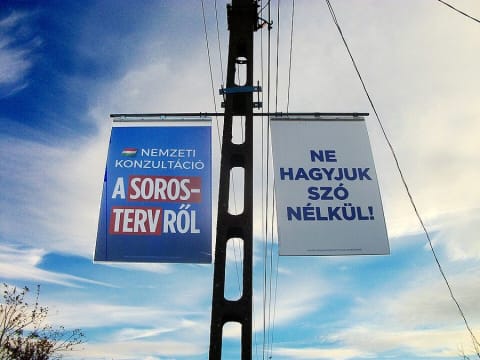
A national consultation questionnaire is posted to eight
million people tying immigration to terrorism, and state
billboards address migrants in Hungarian
-
Anyone against the fence is described as working for the
smugglers or for Brussels
|
Score 3 of 3
-
April 2018: the pro-government weekly Figyelő prints a list
of more than 200 named people at Amnesty, Transparency
International, the universities and the newsrooms as Soros
mercenaries
-
Billboards nationwide show George Soros laughing, and Jewish
organisations in Hungary say the campaign has woken
antisemitism
-
The Stop Soros laws of June 2018 make it a criminal offence
to help an asylum seeker to lodge a claim
|
Score 3 of 3
-
July 2021: investigative journalists and a critical
businessman are found on the target list of Pegasus spyware
bought by the Hungarian state
-
The opposition's joint candidate is presented in state media
as the instrument of Brussels and of Soros rather than as a
rival
|
Score 3 of 3
-
December 2023: a Sovereignty Protection Office is created
that can investigate parties, candidates, newsrooms and
civic groups for foreign influence, helped by the secret
services, with no appeal against its findings
-
Using foreign money in a campaign becomes a crime carrying
up to three years
- Opponents are named the war party, working for Kyiv
|
Score 1 of 3
-
15 March 2025: Orbán says of the politicians, judges,
journalists and civic groups he calls foreign funded that
the bugs have overwintered, and promises an Easter cleaning
-
30 June 2026: parliament abolishes the Sovereignty
Protection Office, 135 to 44, with Fidesz voting against
-
The new prime minister calls the president an Orbán puppet
and the old constitution the founding charter of a Fidesz
Cosa Nostra
|
 Indicator 3
Toleration or encouragement of violence |
Score 0 of 3
-
The Hungarian Guard, the uniformed militia of the far right,
has been dissolved by the courts and the new government
leaves the ban standing
-
Opponents are fought with laws, taxes and appointments, not
with fists
|
Score 1 of 3
-
Spring 2011: uniformed far right groups patrol the Roma
quarter of Gyöngyöspata for weeks while the police hold
back, and families are taken out of the village
-
Parliament annuls convictions from the street clashes of
2006, when Fidesz was in opposition
-
A new law does outlaw unauthorised uniformed patrols, and
the marches thin out
|
Score 0 of 3
-
August 2013: life sentences for the men who murdered six
Roma, including a child. The prosecution is real and the
courts work
-
The large protests of these years are policed without a
crackdown
|
Score 2 of 3
-
16 September 2015: tear gas and water cannon are used on
people pressed against the closed crossing at Röszke
-
Climbing the fence is made a crime with a prison term, and the court in Szeged shelves its other cases to hand it down in fast trials
-
Aid organisations record beatings during pushbacks into
Serbia
|
Score 1 of 3
-
A 2017 law lets anyone found anywhere in the country be
walked back to the far side of the fence, and the beatings
reported with it continue
-
December 2018: tear gas on the crowd outside parliament
during the overtime law protests
|
Score 1 of 3
-
December 2020: the Court of Justice rules the pushbacks
unlawful. They carry on
-
There is no political violence against opponents at home,
and no militia attached to the governing party
|
Score 1 of 3
-
June 2024: Hungary is fined 200 million euros, plus a
million a day, for still refusing asylum claims and pushing
people over the border
-
Opposition politicians campaign, publish and stand without
fear for their lives
|
Score 1 of 3
-
January to August 2025: 3,092 people are walked back across
the fence into Serbia, up from 1,830 in the same months of
2024
-
The border regime outlasts the government that built it.
Magyar promises to keep the border closed and the laws
behind it, and the million euro a day fine for refusing
asylum runs on: 910 million lost by September 2026
-
June 2025: the Budapest Pride the police had banned goes
ahead, the largest in its history, without major incidents
|
 Indicator 4
Readiness to curtail civil liberties and the press |
Score 2 of 3
-
The media laws of 2010 put a Media Council of governing party nominees on nine year terms in place by October, and in December arm it, able to fine
any outlet, print and online included, for coverage it calls
unbalanced
-
Public radio, television and the news agency are merged into
a single state newsroom
-
Four weeklies come out with blank front pages and about 1,500 students march in December; the marches grow through 2011 and the law is amended at the edges
|
Score 2 of 3
-
December 2011: Klubrádió, the one critical talk station,
loses its Budapest frequency in a tender to a company nobody
had heard of
-
Two journalists at the public broadcaster go on hunger
strike over doctored news footage
-
A church law strips more than 300 congregations of legal
recognition, to be restored only by a vote of parliament
|
Score 2 of 3
-
June 2014: an advertising tax written so that the largest
independent broadcaster pays the top rate
-
The editor of the biggest news site is removed after it reports the travel spending of the head of the prime minister's office, and the site passes to
a government ally
-
State advertising money is steered to friendly outlets, the
instrument of the next decade
|
Score 2 of 3
-
8 October 2016: Népszabadság, the largest opposition daily,
is suspended overnight and its journalists are locked out.
The title is sold weeks later to a buyer close to the
government
-
Consultation letters and state billboards put one message
everywhere at public expense
|
Score 2 of 3
-
November 2018: nearly 500 pro-government outlets are handed
to a single foundation, and the government exempts the
merger from competition review by decree
-
April 2017: a higher education law sets conditions Central
European University cannot meet, and it moves its teaching
to Vienna
-
June 2017: foreign funded civic groups must register and
label themselves. The Court of Justice strikes the law down
in 2020
|
Score 3 of 3
-
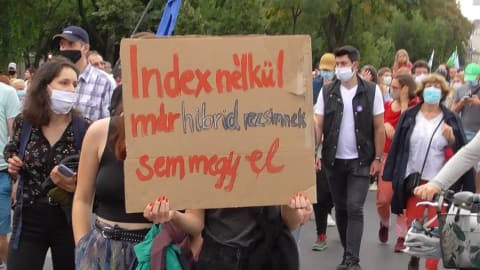
July 2020: the editor of Index, the most read news site in
the country, is sacked and more than seventy journalists
walk out
-
February 2021: Klubrádió is taken off air over paperwork
faults after twenty years, and continues online only
-
June 2021: a law bans any portrayal of homosexuality to
under eighteens in media, advertising and schools
|
Score 3 of 3
-
State advertising, one of the biggest single spends in the
market, goes overwhelmingly to allied outlets, and the
public broadcaster runs as a party service
-
Reporters Without Borders puts Hungary near the bottom of
the European Union throughout
-
Independent sites still publish every day. The pressure here
is ownership and money, not prison
|
Score 1 of 3
-
March and April 2025: Pride is banned by law, 136 to 27,
with facial recognition allowed to identify those who
attend, and a constitutional amendment passed 140 to 21
writes the ban into the Fundamental Law
-
June 2026: parliament votes 145 to 39 to dissolve the state
media holding and replace it with a new broadcaster and news
agency under an independent council. The news channel M1
suspends its news on 7 July while it is rebuilt
-
Not yet undone in September 2026: the Pride ban in the
assembly law and its footing in the constitution. A bill
removing the 2021 limits on portraying homosexuality is only
tabled on 14 September
|
 Indicator 5
Who could still hold him to account
Added, not from the book |
Score 1 of 3
-
The Constitutional Court, then one of the strongest in
Europe, strikes down the retroactive tax. Parliament answers by putting tax and budget law almost beyond its reach
-
A president who signs everything replaces one who used to
send laws back
-
Népszabadság, Origo, RTL Klub and Klubrádió, and a
competitive election in four years
|
Score 1 of 3
-
April 2012: the president resigns after a newspaper shows
his doctoral thesis was copied. The press can still remove a
head of state
-
The European Commission opens cases over the central bank, the data protection authority and the forced retirement of judges, and wins the two that reach the Court
-
The Constitutional Court still annuls laws, including parts
of the media package
|
Score 2 of 3
-
After the Fourth Amendment the Constitutional Court can only check how an amendment was passed, never what it says. The last
domestic institution able to refuse him is gone
-
The street still works: the internet tax is dropped within
days of a hundred thousand people on the streets of Budapest
in October 2014
-
Prosecution service on nine years, audit office on twelve, media council on nine, and the budget council chair named by the president
|
Score 2 of 3
-
The two thirds is lost in by-elections in 2015, and in
November 2016 his amendment on migrant quotas fails by two
votes. Arithmetic still binds him
-
Voters decline to turn out for his own referendum, the one
thing the government cannot arrange for them
|
Score 2 of 3
-
September 2018: the European Parliament triggers Article 7,
the procedure for a member state at risk of breaking the
Union's values. Nothing follows from it for years
-
The Court of Justice is the one body whose rulings he obeys,
and only in part
-
Elections are still real enough to be worth winning by the
methods in the rows above
|
Score 2 of 3
-
Budapest and ten other cities elected opposition mayors in
2019. The government answers by taking away their tax
revenue and drawing a special economic zone around the money
-
Most public universities are handed to foundations whose
boards include serving politicians and sit without a fixed
term
-
A new lever appears: the European budget can now be made
conditional on the rule of law
|
Score 2 of 3
-
December 2022: the Council suspends 6.3 billion euros.
Money, from outside the country, is the lever that moves
him: a law on judicial independence follows in 2023 and
about 10 billion is released
-
February 2024: the president resigns over a pardon in a
child abuse case, after independent reporting, and the biggest protests in years follow her out
-
A small party taken over and rebuilt by a defector from his own ranks takes 30 percent at the European election of June 2024
|
Score 0 of 3
-
12 April 2026: the voters. Sixteen years end at the ballot
box, and power changes hands on 9 May
-
August 2026: the Constitutional Court his majority filled
turns down all of Fidesz's challenges to the amendment that
removed the president, and parliament elects as president, 140 to 6,
András Baka, the Supreme Court president removed early after
criticising Orbán's judicial reforms
-
29 May 2026: the European Union agrees to release 16.4
billion euros frozen under Orbán, tied to reform milestones
the new government still has to meet
|