 Indicator 1
Rejection of the democratic rules of the game |
Score 1 of 3
-
Prosecutors move against candidates before the vote. Rafael Curruchiche, head of the Special Prosecutor's Office Against Impunity (FECI), files complaints against the presidential candidate Edmond Mulet and asks for his immunity to be lifted after Mulet criticises a trial of journalists
-
A complaint about one forged signature in Semilla's founding papers, which the party itself reported in March 2023, is moved from the electoral crimes office to Curruchiche's FECI
|
Score 3 of 3
-
On 12 July 2023, the day the electoral tribunal makes the first round results official, Curruchiche announces that Judge Fredy Orellana has suspended the legal status of Semilla, whose candidate Bernardo Arévalo came second. Article 92 of the electoral law says a party may not be suspended once an election has been called and until it has been held
-
The electoral tribunal tells the prosecutors and the judge that it will not suspend the party
|
Score 3 of 3
-
On 28 August the Citizens Registry provisionally cancels Semilla's registration after a new ruling by Judge Orellana. The full electoral tribunal annuls the suspension on 3 September
-
On 12 September prosecutors open the boxes holding the ballots and tally sheets, which the electoral tribunal calls illegal. On 29 September the attorney general's office seizes the ballots
|
Score 3 of 3
-
The electoral process formally ends on 31 October. On 2 November Semilla is suspended again
-
On 30 November Congress votes, 108 in favour, to lift the immunity of four electoral tribunal magistrates, accused over the software used to transmit preliminary results. Three of them leave the country the next day
|
Score 3 of 3
-
On 8 December prosecutors Rafael Curruchiche and Leonor Morales say they found altered vote counts in the ballot boxes, and Morales says the election of the president, vice president and Congress should be annulled
-
The president of the electoral tribunal, Blanca Alfaro, answers that the results are "valid, official and unalterable"
|
Score 1 of 3
-
No new attempt by the prosecutors to annul the result is reported in the sources read for this page
-
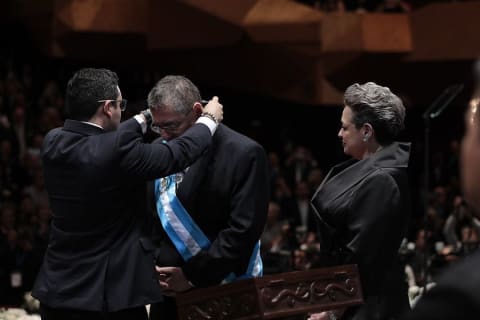
Arévalo is sworn in minutes after midnight on 15 January 2024, about nine hours late, after a dispute in the new Congress over the election of its board
|
Score 2 of 3
-
Porras refuses Arévalo's demands that she resign
-
In November 2024 a judge orders the cancellation of the legal registration of Semilla, the president's party
|
Score 1 of 3
-
Porras seeks a third term. In April 2026 the nominating commission leaves her off its shortlist of six candidates
-
On 5 May Arévalo picks Gabriel García Luna from the shortlist, to take office when her term ends in May
|
Score 0 of 3
-
Out of office.
-
Her successor, García Luna, announces the closure of the FECI at his first press conference, and on 20 May removes Curruchiche from the office and dismisses him from the Public Ministry
|
 Indicator 2
Denial of the legitimacy of political opponents |
Score 2 of 3
-
In July 2021 Porras dismisses Juan Francisco Sandoval, head of the FECI, who leaves the country. Her office then widens investigations of judges, lawyers and prosecutors linked to anti-corruption work; several former FECI and CICIG investigators are arrested in 2022, and the judges Miguel Ángel Gálvez and Erika Aifán go into exile
|
Score 2 of 3
-
Judge Orellana issues arrest warrants for two former Semilla members and asks for the arrest of electoral officials who have immunity
|
Score 2 of 3
-
On 30 August the president of Congress, Shirley Rivera, dissolves Semilla's group in Congress and declares its members independents, Arévalo among them
-
In September prosecutors ask for the immunity of all the electoral tribunal's magistrates to be lifted
|
Score 3 of 3
-
On 16 November prosecutors say they will ask the Supreme Court to lift the immunity of the president-elect and the vice president-elect, Karin Herrera, accusing them of encouraging, in social media posts, the occupation of the state university in 2022
-
The National Institute of Forensic Sciences reports no indication that Arévalo and Herrera took part. The prosecutors continue the case
|
Score 2 of 3
-
The same day the prosecutors ask for Arévalo to be stripped of immunity over the gathering of signatures and the handling of party funds
|
Score 2 of 3
-
On 11 January 2024 the Public Ministry orders the arrest of the four electoral magistrates who had lost their immunity and were living in exile
-
The same day Herrera asks the Constitutional Court for protection against a possible arrest warrant, and the court later grants her an order protecting her immunity
|
Score 2 of 3
-
On 21 August 2024 Curruchiche asks the Supreme Court to lift President Arévalo's immunity for "abuse of authority" and other offences. By December 2024 prosecutors have asked at least six times
|
Score 2 of 3
-
On 23 April 2025 police detain Luis Pacheco, who had led the 48 Cantons of Totonicapán in the 2023 protests and is now a deputy minister, and Héctor Chaclán. Prosecutors accuse them of terrorism, sedition, unlawful association and obstruction, and say the protesters meant to take over the attorney general's headquarters, without giving evidence, according to Human Rights Watch
|
Score 0 of 3
-
Out of office.
-
On 12 September 2026 Judge Mynor Moto dismisses the case against Pacheco, Chaclán, Basilio Puac and Esteban Toc at the request of the prosecutors, who found that organising the 2023 protests broke no law
|
 Indicator 3
Toleration or encouragement of violence |
Score 0 of 3
-
No violence by the prosecutors or by anyone acting for them is reported in the sources read for this page
|
Score 0 of 3
-
None reported. The threat in this period is legal, not physical
|
Score 0 of 3
|
Score 1 of 3
-
Prosecutors press the Interior Ministry to clear the road blockades, as the Constitutional Court had ordered on a petition from business owners, and accuse the interior minister, David Napoleón Barrientos, of disobedience for not doing so. He resigns on 17 October
-
On 16 October one protester is killed and four people are hurt in clashes in Malacatán, where about 50 people armed with guns, sticks and stones took part
|
Score 0 of 3
|
Score 1 of 3
-
On 11 January 2024 Barrientos is arrested, accused of failing in his duties by not using force to clear the October blockades
|
Score 0 of 3
|
Score 0 of 3
|
Score 0 of 3
-
Out of office. None reported
|
 Indicator 4
Readiness to curtail civil liberties of opponents, including media |
Score 2 of 3
-
In late July 2022 police arrest José Rubén Zamora, founder of elPeriódico, which had accused President Giammattei and Porras of corruption, and search the paper's offices
-
During Zamora's trial in 2023 a judge asks for nine journalists to be investigated. Some journalists leave the country
|
Score 2 of 3
-
On Judge Orellana's order Semilla's headquarters is searched. The party's lawyers file a habeas corpus petition for the staff inside
|
Score 2 of 3
-
Prosecutors raid Semilla offices around the country. Arévalo suspends his part in the transition, calling the raids "flagrant crimes of abuse of authority for electoral purposes", and resumes it on 4 October
|
Score 2 of 3
-
In the university case the attorney general's office asks for 27 arrest warrants against activists, students, academics, human rights defenders and a member of Semilla
|
Score 2 of 3
-
No new raid or arrest by the prosecutors in these seven days is reported in the sources read. The university case and the warrants asked for in November stay open, and Zamora stays in prison
|
Score 2 of 3
-
Zamora is still in prison, and the prosecutions of former anti-corruption prosecutors and judges continue. He is moved to house arrest only in October 2024
|
Score 2 of 3
-
On 13 August 2024 Ligia Hernández, head of the national victims' institute, is detained on campaign finance charges. She spends three months in pretrial detention before accepting a plea deal
-
In November 2024 an appeals court sends Zamora back to prison, overturning the house arrest granted in October
|
Score 2 of 3
-
On 25 April 2025 a judge orders Pacheco and Chaclán held in pretrial detention. The case is kept under seal
|
Score 0 of 3
-
Out of office.
-
García Luna sets up a commission to review the cases of people prosecuted under Porras, and dismisses at least eight senior prosecutors close to her
|
 Indicator 5
Who could still hold the prosecutors to account
Added, not from the book |
Score 2 of 3
-
The attorney general serves a fixed four-year term, and the president may remove her only for a justified cause, which the Public Ministry's organic law defines as a conviction for a crime committed in office. Giammattei gives Porras a second term in 2022, to run until 2026
-
In September 2021 the United States puts her on its list of corrupt and undemocratic officials
|
Score 1 of 3
-
On 13 July, the day after the suspension, the Constitutional Court reverses it, and Semilla stays in the runoff. Arévalo wins on 20 August with about 61 percent
|
Score 2 of 3
-
The electoral tribunal refuses to suspend Semilla while the electoral process runs, and annuls the Registry's suspension. Once the records are taken, its magistrates say they can no longer vouch for their contents
|
Score 2 of 3
-
From 2 October Indigenous authorities led by the 48 Cantons of Totonicapán block roads across the country to demand the resignation of Porras, Curruchiche and Orellana; by 11 October as many as 140 roads have been blocked. Porras does not resign
-
President Giammattei tells the protest leaders that the law does not let him ask for her resignation. On 2 November the United States withdraws the visas of 14 people in the Public Ministry
|
Score 1 of 3
-
On 14 December the Constitutional Court, by 4 to 1, upholds the results, rejects the prosecutors' moves to have the election annulled and orders Congress to guarantee Arévalo's inauguration
|
Score 1 of 3
-
On 14 January 2024 the incoming Semilla members negotiate a majority of 92 votes to elect Samuel Pérez president of Congress, and the new board goes ahead with the inauguration
|
Score 2 of 3
-
On 2 February 2024 the European Union sanctions Porras. Canada follows the same month
-
Arévalo's request of February 2024 to lift Porras's immunity is rejected by the Supreme Court in August. His bill to allow her dismissal, delivered to Congress on 6 May 2024, gets no plenary session before the recess
|
Score 2 of 3
-
On 22 April 2026 the Supreme Court rejects outright a request by a member of Congress, José Chic, to lift Porras's immunity over irregular adoptions and other alleged crimes. What ends her time in office is the end of her term
|
Score 1 of 3
-
As of 28 September 2026 the Public Ministry has confirmed, on 25 September, that it is investigating several complaints against Porras, about selective prosecutions of former justice officials and journalists and about illegal adoptions. It says this does not mean criminal responsibility has been established, and no charge, arrest warrant or summons against her was found in a search on that date
|