 Indicator 1
Rejection of the democratic rules of the game |
Score 1 of 3
-
He wins the runoff of June 1990 as an outsider with no
majority in either chamber, and governs by delegated
decree: given powers by Congress in June 1991, he issues
126 legislative decrees, 79 of them in November alone
-
Congress votes to repeal six of the thirty-seven decrees
on counter-insurgency before the session closes on 15
December 1991, and he refuses to promulgate the repeals.
It then passes a law subjecting his decrees to
parliamentary control; he vetoes that too, both chambers
re-enact it over his veto on 31 January 1992, and he
names it in his coup address as proof that Congress was
handcuffing the presidency
|
Score 3 of 3
-
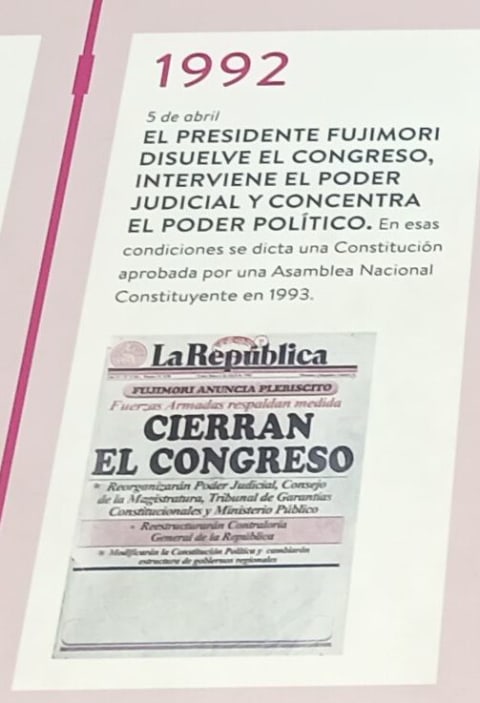
On the night of Sunday 5 April 1992 he goes on
television, dissolves both chambers of Congress and
sends the army to the building. Decree Law 25418, signed
the next day, gives the executive all legislative power,
suspends every article of the constitution that
contradicts it, and decrees the wholesale reorganisation
of the courts, the public prosecutor, the judicial
council, the comptroller and the tribunal of
constitutional guarantees. Within three days separate
decrees sack the comptroller, thirteen Supreme Court
judges and the judicial council, and on 8 April a decree
of a single article sacks every member of the tribunal
of constitutional guarantees
-
The dissolved Congress meets anyway, declares the presidency
vacant and swears in the first vice president, Máximo San
Román. The armed forces do not obey and San Román never
governs
-
Under pressure from the Organization of American States he
announces on 18 May an election for a constituent congress,
held on 22 November
|
Score 2 of 3
-
The constituent congress elected on 22 November 1992,
with Acción Popular, APRA and the left staying out of
the vote, gives his alliance 44 of the 80 seats. On 6
January 1993 its first constitutional law puts the 1979
constitution back in force except where it conflicts
with what he had done since the coup, takes the
legislative power to itself, and declares him
constitutional president
-
The constitution that body writes is approved by referendum
on 31 October 1993 with about 52 percent. It replaces the
two chambers with one, and lets a president be re-elected
once
|
Score 2 of 3
-
He stands again under the re-election clause his own
assembly had written, the national elections board
having ruled in 1994 that his standing in 1995 would
count as a re-election, and on 9 April he takes about 64
percent against Javier Pérez de Cuéllar
-
His alliance wins a majority of the 120 seats in the single
chamber, and the parties that had governed Peru in the 1980s
are left with a few percent each
|
Score 3 of 3
-
On 23 August 1996 his majority passes Law 26657, an
"authentic interpretation" of article 112 declaring that
terms begun before the 1993 constitution took effect are
not counted, which takes his 1990 term out of the
calculation and leaves him free to stand in 2000
-
Three of the seven judges of the Constitutional Tribunal
rule in January 1997 that the law cannot be applied to
him. On 28 May Congress votes, by a simple majority of
those present, to remove all three
|
Score 3 of 3
-
As many as 1.4 million signatures are gathered for a
referendum to repeal that law. The elections board rules
that under a 1996 statute a referendum needs 48 votes in
Congress; on 27 August 1998 it gets 45, and a right written
into the constitution is closed off by a vote with no
judicial review left to appeal to
-
In May 1998 Congress raises the number of elections board
votes needed to uphold a challenge to a candidacy from three
of five to four, and in July 1999 the government declares
that Peru is leaving the contentious jurisdiction of the
Inter-American Court of Human Rights with immediate effect,
which the Court itself held could not be done
|
Score 3 of 3
-
He runs for a third term. On 9 April he is credited with
49.87 percent of the valid votes, 45.8 percent of all
the ballots cast, short of an outright win, and the
Organization of American States observation mission led
by Eduardo Stein withdraws its observers before the
second round rather than watch it
-
Alejandro Toledo refuses to contest the runoff of 28 May
and asks voters to spoil their ballots. 29.9 percent of
the ballots cast are spoiled and another 1.2 percent are
blank, and Fujimori is sworn in on 28 July
|
 Indicator 2
Denial of the legitimacy of political opponents |
Score 1 of 3
-
He runs and then governs against the parties as a class
rather than against their policies. The Truth Commission
dates the shift to July 1991, when his own bench lost the
presidencies of both chambers and he set about discrediting
Parliament in public, questioning what its functions were
for and calling it inoperative. Apoyo's polling has his own
approval at 60 percent in December 1990 and a little above
30 percent by the end of 1991
-
He spends September and October 1991 attacking what he
calls pseudo human rights organisations for what he says
is their silence about the insurgency, and in November
names Amnesty International and Americas Watch, the
Americas arm of Human Rights Watch
|
Score 3 of 3
-
On the night of the coup soldiers detain the president of
the Chamber of Deputies, Roberto Ramírez del Villar, the
congressman César Barrera Bazán and the journalist Gustavo
Gorriti
-
Troops go to the house of the former president Alan García.
He gets over a wall, hides for eight weeks and enters
the Colombian embassy on 31 May
-
A court convicted Fujimori in 2009 of the kidnapping of
Gorriti, taken that night, and of the businessman Samuel
Dyer, seized at Lima airport on 27 July as he tried to
fly out
|
Score 2 of 3
-
General Rodolfo Robles names Vladimiro Montesinos and a
special operations detachment inside the army, the squad
later known as Colina, in an open letter of 6 May 1993
as the authors of Barrios Altos and La Cantuta. He and
his two sons, both serving officers, are prosecuted in
the military courts for insulting the nation and the
armed forces; he is expelled from the army and takes
asylum in Argentina
-
When a congressional commission takes evidence on La
Cantuta in April 1993, the army answers by running tanks
and troops through Lima on 21 April. The high command
and the heads of every military region gather at the
Pentagonito to back the commanding general, and a
communiqué from the armed forces high command is enough
to make Fujimori, who had criticised the tanks, turn
round and criticise Congress instead
|
Score 2 of 3
-
His former wife Susana Higuchi, who had called his
government corrupt and been stripped of the title of first
lady in 1994, is kept off the 1995 ballot when the
elections board refuses to register her
group's presidential ticket and then its
list of candidates for Congress.
The Inter-American Commission found in October 1999 that
Peru had violated her right to political participation
-
Three retired officers are charged in April with
insulting the nation and the armed forces after
criticising in public how the war with Ecuador had been
fought, and two of them are jailed. They are out by 30
May, and the June amnesty wipes the charges
|
Score 3 of 3
-
On 13 July 1997 the immigration authorities publish a
resolution, signed two days earlier, revoking the
Peruvian citizenship of Baruch Ivcher thirteen years
after he was naturalised, on the ground of
irregularities in the original application. It is his channel that had been
running the stories about the intelligence service
-
The United States human rights report for 1997 records
harassment of journalists severe enough to create the
perception of an organised campaign of intimidation by the
armed forces and the intelligence services
|
Score 3 of 3
-
Four tabloids run front page attacks in near identical
language, calling the investigative reporters of La
República traitors, Ecuadorian spies and terrorist
sympathisers, and the reporters and
their families are sent death threats by telephone
-
Ivcher, by then abroad, is tried in his absence for customs
fraud and sentenced to twelve years. José Arrieta, who
ran the
investigations unit
at his channel,
leaves the country
in January 1998 on
learning that he is
about to be
arrested; he is
charged in his
absence in March
and tax officials
call on his family
in May
|
Score 3 of 3
-
Alberto Kouri and enough other members elected on
opposition lists cross to the government benches, in the
days before the new Congress meets, to give it the
majority the election had denied it. The majority shows
itself on 26 July, when the government's slate for the
Mesa Directiva, headed by Martha Hildebrandt, is elected
by 70 votes to 46 in a chamber of 120. Kouri was later
sentenced for taking the money
-
When the march of 26 to 28 July ends in rioting and a fatal
fire, the government blames the organisers and uses the
violence against Toledo
|
 Indicator 3
Toleration or encouragement of violence |
Score 2 of 3
-
On the night of 3 November 1991 six hooded men walk into a
fundraising barbecue at Jirón Huanta 840 in Barrios Altos,
order everyone to the floor and fire for about two minutes,
killing fifteen people including an eight year old boy and
wounding four. The gunmen were later identified as members
of Grupo Colina, a death squad made up of army personnel
-
In 2009 a court found that Fujimori had ordered the Colina
squad to carry out this killing and the one at La Cantuta
|
Score 3 of 3
-
On 18 July 1992, two days after Shining Path car bombs in
Tarata street in Miraflores killed twenty five people, the
Colina squad takes nine students and a professor out of
their rooms at La Cantuta university at night. They are not
seen again
-
Nine people are taken and killed in Santa province on 2 May,
and the killers paint Shining Path slogans afterwards
|
Score 3 of 3
-
Congress passes Law 26291, the Cantuta law, in the small
hours of 8 February 1994 with no committee report and
immediate effect; Fujimori signs it the next day and it
is published on 10 February. It lets a jurisdiction
dispute in the Supreme Court be settled by a simple
majority instead of four votes of five. The criminal
chamber had split three to two for the military courts
on 4 February and was one vote short; on 11 February the
same three send the case across. The prime minister,
Alfonso Bustamante, resigns over it a week later
-
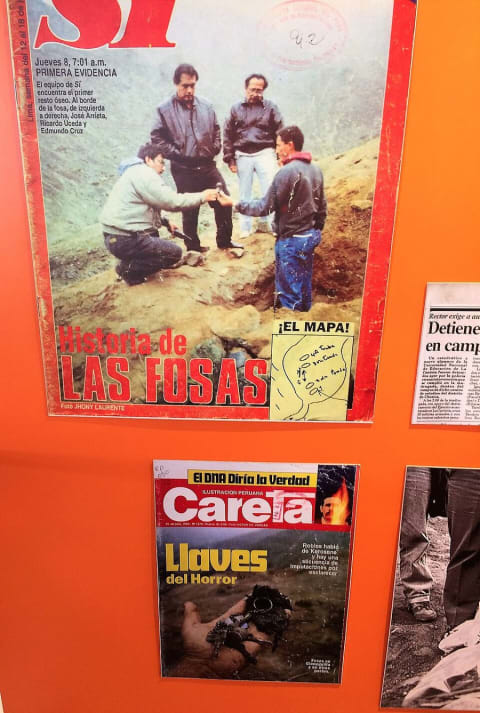
Burnt fragments of at least five of the La Cantuta
victims had been found at Cieneguilla on 8 July 1993, in
two of four clandestine graves, by reporters working
from a map, not by the state. The graves where all ten
were first buried, at Huachipa, were found in November
1993, again after the magazine had reported them
|
Score 3 of 3
-
On 14 June 1995 the outgoing constituent Congress passes
Law 26479, an amnesty for the military, the police and
civilian state personnel involved in the
counter-insurgency since May 1980, except those charged with
drug trafficking, terrorism or treason. It reaches the
men convicted of La Cantuta and the killers at Barrios
Altos
-
Judge Antonia Saquicuray rules on 16 June that the
amnesty cannot apply to Barrios Altos. Within a
fortnight Congress passes a second law, 26492, putting
the amnesty beyond judicial review, and on 14 July the
Eleventh Criminal Chamber of the Lima Superior Court
revokes her ruling and closes the case
|
Score 3 of 3
-
The national family planning programme begins sterilising
women in numbers: fewer than 15,000 a year before it,
about 82,000 in 1996 and about 110,000
in 1997, with quotas for
health workers and bonuses of four to ten dollars a case,
concentrated on poor and indigenous women
-
Leonor La Rosa, an army intelligence agent, is tortured
by her own service, and the dismembered body of another
agent, Mariela Barreto, is found on 23 March 1997.
Nobody was convicted for twenty-six years; in 2023 a
Lima court found that Montesinos had ordered her killed
under Plan Tigre, the counter-intelligence protocol for
leakers, and sentenced him and Santiago Martín Rivas to
twenty-three years each
-
Commandos retake the Japanese ambassador's residence on 22
April 1997 after four months, killing all fourteen of the
hostage takers; one hostage and two commandos also die,
and a freed hostage, the Japanese
diplomat Hidetaka Ogura, later said
captors were killed after surrendering;
in 2015 the Inter-American Court found
that one of them, Eduardo Cruz Sánchez,
had been executed
|
Score 2 of 3
-
In February 1998 two of the four officers jailed over
the torture of Leonor La Rosa are quietly released
-
Police beat students at the first of five protest rallies in
central Lima, and on 30 September 1998, after about two
hundred demonstrators break into the
presidential palace, the
security forces use tear gas and fire some shots
|
Score 2 of 3
-
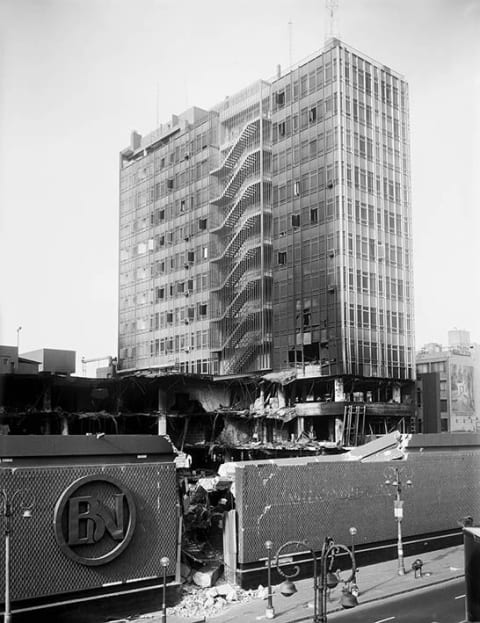
Six security guards die in a fire at the Banco de la
Nación in central Lima during the march of 28 July. The
government blamed the marchers and the organisers blamed
the state. In 2009 a Lima court convicted Montesinos of
the attack as its indirect author and gave him ten
years, and the former national police chief six, though
it acquitted him of the guards' deaths for want of
direct proof
-
The march is broken up with tear gas and water cannon,
and more than two hundred are detained, about twice the
number the police admitted to
|
 Indicator 4
Readiness to curtail civil liberties and the press |
Score 1 of 3
-
Among the counter-insurgency decrees of November 1991 is
decree 762 of 8 November, which writes a new article
into the penal code: five to ten years in prison for
anyone who by any means reveals, reproduces, exhibits or
circulates secret information or activities of the
National Defence System. Congress votes to repeal it
before the session closes on 15 December and he refuses
to promulgate the repeal
-
Nearly half the territory and more than half the
twenty-two million population are under emergency rule, where
constitutional protections are suspended and military
commands supersede the civilian authorities
|
Score 3 of 3
-
From half past ten on the night of 5 April the military
occupy newspapers, radio and television for about forty
hours. Every paper comes out under supervision and none is
allowed to print the word coup
-
The anti-terrorism decrees that follow let civilians be
tried for treason in closed military courts, by judges whose
names and faces are hidden
|
Score 2 of 3
-
The emergency system stays: civilians tried for treason
by military courts and for terrorism by faceless
civilian ones, and enough wrongful convictions that an
ad hoc pardons commission created in 1996 had 360 people
pardoned and released by the end of 1997
-
The press is free enough to break the state's biggest
secret. It is reporters from the magazine Sí, following
a map they were sent, who dig at Cieneguilla on 8 July
1993 and find the first bones, and only then call the
prosecutors. The state answers with a criminal complaint
against the magazine's editor and a taxi driver paraded
on television as the map's author, whom the courts found
innocent months later
|
Score 2 of 3
-
During the January and February border war with Ecuador
the army lets journalists to the front only on official
trips and keeps the foreign press away for the first
week. In the week after the ceasefire unidentified men
search Peruvian reporters' hotel rooms at the border and
go through their videotapes
-
The press itself is still broadly free, and on 9 June
Law 26470, a constitutional amendment the constituent
Congress had voted on 31 May, takes out of the media's
reach the habeas data clause that journalists had feared
would be used to force rectifications on them
|
Score 3 of 3
-
Channel 2 broadcasts the torture of an army intelligence
agent, the wiretapping of journalists and politicians,
and Montesinos's tax return. Its owner then loses his
citizenship, and with it his control of the station,
under a law that bars foreigners from owning a
broadcaster: a newly appointed judge suspends his rights
as majority shareholder and hands the company to his
minority partners
-
His minority partners take the channel over, much of the
news and administrative staff resign, and very few stories
critical of the government appear on it afterwards
-
The pressure is not all one way: on 15 October 1997 the
faceless tribunals lapse, military treason trials go on
with named judges, and civilian terrorism trials are
suspended until new specialised courts can be built
|
Score 3 of 3
-
The intelligence service is buying the news. From the
payment records recovered later, the economists John
McMillan and Pablo
Zoido counted bribes of
mostly 5,000 to 10,000
dollars a month for
Supreme Court and
Superior Court judges,
two or three times
their official
salaries, and 5,000 to
20,000 for politicians,
against 1.5 million
dollars a month for the
biggest television
channel
-
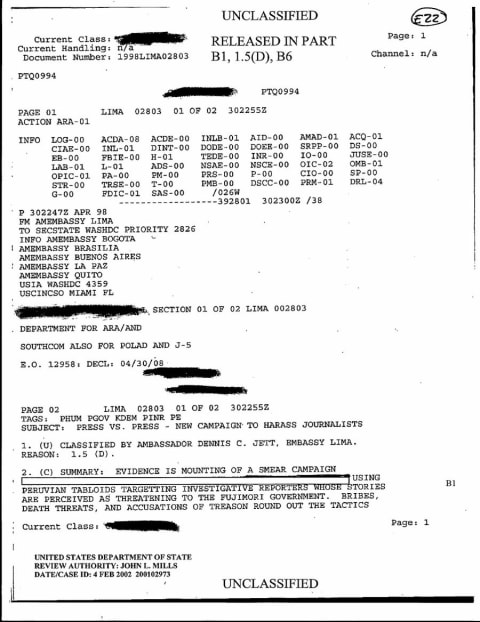
A United States embassy cable from Lima of 30 April 1998
reports mounting evidence of a smear campaign using Peruvian
tabloids against reporters whose stories are seen as
threatening to the government, with bribes, death threats
and accusations of treason
|
Score 3 of 3
-
One of the recordings, released the following February,
has Montesinos saying of the broadcast channels that
they are all lined up, and that he meets them every day
to plan what goes out on the evening news
-
The one television channel he had not bought was Canal
N, a small cable news channel, and it was Canal N that
put the Kouri tape on air on 14 September
|
 Indicator 5
Who could still hold him to account
Added, not from the book |
Score 1 of 3
-
A Congress of two chambers that he does not control,
which votes to repeal six of his decrees, sees him
refuse to promulgate the repeals, and then legislates to
limit his power to issue them
-
A tribunal of constitutional guarantees, a Senate
commission opening an investigation into Barrios Altos,
a first vice president elected on his own ticket, and a
press still free enough to print the army's own plan for
the Barrios Altos block a week after the killings,
though journalists were among those the security forces
harassed that year
|
Score 2 of 3
-
In one night all of it goes. The dissolved Congress votes
him out and swears in Máximo San Román, the armed forces
ignore it, and San Román never governs
-
What still bites is outside the country. The United
States suspends aid and other donors follow, Venezuela
breaks off relations, Washington rejects his plan for a
referendum to ratify the coup, the OAS presses for an
elected assembly instead, and he calls a constituent
election
-
Inside it, the answer is approval. An Apoyo poll on 7
April found 71 percent for the closing of Congress and
89 percent for the remaking of the courts, and a
counter-coup on 13 November led by General Jaime Salinas
Sedó fails
|
Score 2 of 3
-
Voters are still a real obstacle. The constitution he
had ordered written is approved on 31 October 1993 by
about 52 percent against 48, carrying ten departments
and losing fourteen, a margin narrow enough to be a
warning
-
Everything else has moved. The assembly elected under
the boycott declares him constitutional president, and
the ordinary courts lose the Cantuta case to the
military ones, three votes of the Supreme Court's
criminal chamber being enough once Congress had lowered
the majority it needed
|
Score 2 of 3
-
A judge still refuses him. Antonia Saquicuray rules on
16 June 1995 that the amnesty cannot cover Barrios
Altos, Congress answers within a fortnight by putting
the amnesty beyond the reach of any court, and on 14
July the appeal chamber revokes her ruling, closes the
case and orders her investigated for interpreting the
law wrongly
-
The ballot box is not refusing him either: about 64 percent
in April and a majority of the single chamber
|
Score 3 of 3
-
On 28 May 1997 Congress removes the three judges of the
Constitutional Tribunal who had ruled against a third
term, on the stated ground of an irregularity in a
procedural clarification. The four who are left can no
longer strike down a law, which needs six votes of
seven, though they go on rejecting the amparos brought
against him, including the three judges' own
-
Twenty-seven members of Congress take the case to the
Inter-American Commission, which finds it admissible and
in December 1998 gives Peru sixty days to put the judges
back. They are not put back
|
Score 3 of 3
-
In March 1998 the power to dismiss Supreme Court judges and
prosecutors moves from the independent judiciary council to
commissions run by his allies, and all seven members of the
council resign in protest. By the end of that year 19 of the
33 judges of the Supreme Court hold their seats
provisionally
-
The 1.4 million signatures die on 45 votes in August, and in
July 1999 the government announces that it is leaving the
contentious jurisdiction of the Inter-American Court, so
even the bench outside the country is one he says he need
not answer to
|
Score 3 of 3
-
Nothing institutional refuses him until September. The
elections board clears the third candidacy, the
observers leave rather than watch the runoff, he is
sworn in on 28 July, and the Congress the election had
not quite given him becomes his when enough members
elected on opposition lists cross the floor
-
What ends it is a videotape. A secretary took cassettes out
of the intelligence service, opposition politicians bought
one, and on 14 September Canal N broadcast Montesinos
counting 15,000 dollars into the hand of a congressman he
was buying
-
He resigns by fax from the New Otani hotel in Tokyo on
19 November. Congress never puts the resignation to a
vote, and on 21 November it declares the presidency
vacant for permanent moral incapacity by 62 votes to
nine, with nine abstentions
|