 Indicator 1
Rejection of the democratic rules of the game |
Score 2 of 3
-
25 October: Law and Justice takes 37.6 percent of the vote
and 235 of the 460 seats in the Sejm, the first single party
majority since the end of communism, on 50.9 percent turnout
-
On 25 November the new Sejm declares void the election of
five Constitutional Tribunal judges by the outgoing one, and
on 2 December elects five of its own. The president swears
four of them in after midnight that same night and the
fifth a week later, and never swears in the three the
Tribunal then rules were lawfully chosen
-
That ruling of 3 December goes both ways: it upholds the
election of three of the October judges and strikes down the
other two, which was the new majority's own case. It is
printed on 16 December, after the prime minister's office
writes to ask whether it should be published at all. A law
of 22 December raises the number of judges who must sit on a
full bench case from nine to thirteen of fifteen
|
Score 2 of 3
-
9 March: the Tribunal rules the December amendment
unconstitutional. The government refuses to publish this
judgment as well, on the ground that the court had not
followed the procedure laid down in the December amendment,
which required thirteen judges to sit when only twelve were
available
-
11 March: the Venice Commission finds that the amendments
cripple the court and endanger the rule of law. Three
judgments given in 2016, K 47/15, K 39/16 and K 44/16, stay
out of the gazette until 5 June 2018 and are then printed
stamped as issued in violation of law
-
16 December: with the chamber occupied by opposition
members, the 2017 budget is voted in the Column Hall. The
opposition says it could not get in to vote and that the
count cannot be checked. The vote is never rerun
|
Score 2 of 3
-
24 July: after more than a week of protest the president
vetoes two of the three judiciary bills, on the Supreme
Court and on the National Council of the Judiciary. The next
day he signs the third, on the ordinary courts
-
That third law gives the justice minister six months, from
12 August, to replace the president or deputy president of
any ordinary court without stating a reason and with no
appeal. He starts on 13 September, and by 20 December he has
dismissed 24 court presidents and appointed at least 32. The
window closes on 12 February 2018
-
In December he signs his own versions of the two he vetoed.
The choice of the judicial council's fifteen judicial members
still moves from the judges to parliament
|
Score 2 of 3
-
From 3 April 2018 a new Supreme Court law lowers the
retirement age from 70 to 65, which would remove roughly a
third of the court, the First President among them, nearly
two years before her six year constitutional term ends in
April 2020. She refuses to go and turns up for work
-
6 March 2018: the Sejm elects the fifteen judicial members
of the National Council of the Judiciary, which the judges
had chosen themselves until then. The council nominates
every judge in the country
-
October 2018: the Court of Justice orders the retirements
suspended. A Polish law of November 2018 puts the judges
back, and the Court rules against Poland in June 2019
|
Score 2 of 3
-
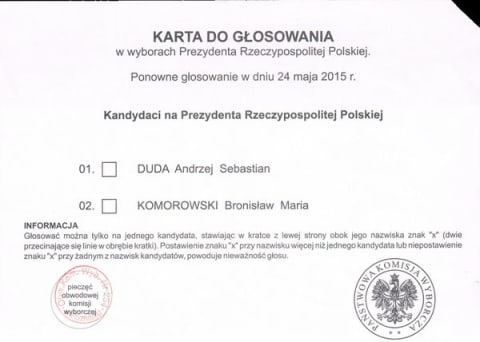
10 May: the presidential election ordered for that day does
not take place. No body cancels it. Ballot papers for a
postal vote had been printed while the law authorising it
was still unfinished, and that same day the National
Electoral Commission resolves that there had been no
possibility of voting for candidates
-
In September a Warsaw administrative court finds the prime
minister's April instruction to the post office was issued
without legal basis and in gross breach of the law
-
The vote is held on 28 June and 12 July. The incumbent wins
51.03 to 48.97 on 68.2 percent turnout, and the count is not
disputed
|
Score 2 of 3
-
7 October 2021: asked by the prime minister, the
Constitutional Tribunal rules that parts of the Treaty on
European Union are incompatible with the Polish
constitution, in so far as they let Polish courts review how
judges here are appointed, and in so far as European bodies
act beyond the powers Poland conferred
-
The bench that rules it includes three judges elected to
seats that were already filled. In May 2021 the European
Court of Human Rights had held that a Tribunal panel
including one of them was not a tribunal established by law
-
Poland refuses to pay the daily penalties imposed from
Luxembourg, and the government's position is that the
rulings fall outside the Union's competence
|
Score 1 of 3
-
15 October: turnout is 74.4 percent, the highest of any
Polish election since 1989. Law and Justice comes first with
35.4 percent and 194 seats, has no majority, and accepts the
result
-
A government written referendum is put on the same day.
Voters take the election ballot and decline the referendum
one: it draws 40.9 percent, below the half needed to make it
binding
-
In May a law had created a commission able to bar a person
from handling public money for up to ten years for acting
under Russian influence. That power was stripped out by an
amendment in force from 8 August, three weeks before the
Sejm appointed the commission's members on 30 August, and
nobody is barred before the election
|
Score 1 of 3
-
6 March 2024: the new Sejm majority resolves that the Constitutional Tribunal can no longer perform its constitutional tasks, and from then on the government declines to publish the Tribunal's rulings, on the ground that it seats judges who were unlawfully appointed
-
The presidential election is held on schedule. Karol Nawrocki, the candidate Law and Justice backs, wins the run off on 1 June 2025 with 50.9 percent. More than 53,000 protests are filed, and on 1 July the Supreme Court chamber the government regards as unlawful confirms the result. The justice minister calls that chamber illegitimate, the Speaker of the Sejm accepts its ruling, and Nawrocki is sworn in on 6 August
-
13 March 2026: the Sejm elects six Constitutional Tribunal judges. On 1 April the president swears in two of them. The other four take their oath before a notary in the Sejm on 9 April, and the Tribunal's chief justice refuses to admit them
|
 Indicator 2
Denial of the legitimacy of political opponents |
Score 1 of 3
-
11 December, on a friendly television channel: the party
leader says that national betrayal runs in the genes of some
people, that these are the worst sort of Poles, and that this
sort is unusually active just now
-
A court later throws out a suit brought by an activist of
Obywatele RP, holding that it cannot be established who the
words were aimed at, so no one person's rights were
infringed
|
Score 2 of 3
-
16 December: opposition members occupy the chamber of the
Sejm after the Marshal throws a member out for holding up a
Free Media card, in a row over a plan to move the press out
of the main building and cap each newsroom at two
correspondents. The party leader calls it an attempted
putsch. The occupation runs to 12 January 2017
-
The press plan is dropped in January 2017. The people who
stopped it are by then established in government language as
an enemy rather than an opposition
|
Score 2 of 3
-
18 July, in the Sejm, during the first reading of the
Supreme Court bill: the party leader turns on the opposition
benches,
calls them traitors to their faces and tells them they
murdered his brother. The Sejm ethics committee reprimands
him and he does not appeal
-
The brother is the president killed in the Smolensk air
crash of 2010, which the 2011 Polish and Russian
investigations both found was an accident
-
The bills themselves are sold as a fight against a caste of
privileged judges, rather than as a change to who appoints
them
|
Score 3 of 3
-
Between April and October 2019 the phone of the member of
the Sejm running the opposition's parliamentary campaign,
who wins a Senate seat at that election, is broken into 33
times with Pegasus spyware bought by the Polish
state. Messages taken from it are altered and broadcast by
state television during the campaign. Citizen Lab
establishes this and it becomes public in December 2021
-
From the spring of 2019 the party fights on LGBT rights as
an import that threatens Polish identity and the nation
-
From April 2019 municipalities and counties begin adopting
resolutions against LGBT ideology or a family charter. By
mid 2020 about a hundred of them and five of the sixteen
regions have done so, covering roughly a third of the
country by area. Polish courts later annul several as
unconstitutional
|
Score 3 of 3
-
13 June, at a campaign rally: the president says his
parents' generation spent forty years getting communist
ideology out of the schools and did not fight so that a new
and even more destructive one could take its place. He is
talking about LGBT rights
-
A member of his campaign staff says the same day, on the
state news channel, that people should stop listening to
idiocies about human rights
and equality, because these people are not equal to normal
people
-
15 June: the state broadcaster's main news programme tells
viewers that money for Polish families will dry up if the
opposition candidate wins and satisfies Jewish claims. The
Media Ethics Council says the broadcast incited hatred, and
OSCE observers find the public broadcaster frequently
portrayed the main challenger as a threat to Polish values
and national interests
|
Score 2 of 3
-
December 2021: Citizen Lab confirms the spyware was also
used against a lawyer acting for opposition politicians and
against a prosecutor who had looked into the abandoned
postal election. The party leader confirms Poland bought the
system, and the government's answer is that no surveillance
is possible without a court's consent
-
The Senate, which the opposition holds, opens an inquiry in
January 2022. The Sejm, which the government holds, refuses
to open one
-
The opposition leader, a former president of the European
Council, is run in government media as Berlin's man rather
than as a rival
|
Score 2 of 3
-
29 May: the president signs a law creating a state
commission on Russian influence that can bar a person from
handling public money for up to ten years. Critics call it
lex Tusk. The European Commission opens an infringement
case, the president then asks parliament to amend the law,
and the commission bars nobody before the vote
-
Two of the referendum's four questions ask voters whether
they want thousands of illegal immigrants let in under a
European mechanism and whether they want the border wall
taken down
-
The last weeks are fought on migration and on Brussels, with
the opposition cast as the side that would open the border
|
Score 1 of 3
-
9 January 2024: police enter the presidential palace and detain two former Law and Justice ministers to serve two year sentences for abuse of power. A former prime minister of the party calls them the first political prisoners of Tusk's regime. The president pardons them on 23 January
-
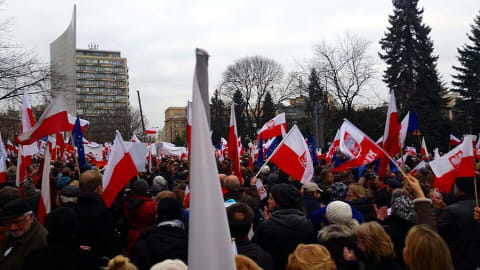
11 January 2024: Law and Justice leads a March of Free Poles in Warsaw against the takeover of public media and the jailing of the two ministers. City hall puts the crowd at 35,000
-
The government side answers in kind: the justice minister calls the Tribunal's 12 May 2026 ruling a political setup, and the prime minister says the president vetoes blindly, just to cause harm
|
 Indicator 3
Toleration or encouragement of violence |
Score 0 of 3
-
There is no militia, no party street wing and no political
killing. Opponents are fought with laws, appointments and
the official gazette
-
The nationalist Independence March goes through Warsaw on 11
November as it does every year, organised by groups outside
the governing party, five days before the new government is
sworn in
|
Score 1 of 3
-
13 December: parliament passes a change to the law on
assemblies giving priority to recurring assemblies at the
same place and hour, which would secure the ground for the
monthly Smolensk marches and keep counter demonstrators at a
distance. The president sends it to the Constitutional
Tribunal on 28 December, the Tribunal upholds it on 16 March
2017, he signs it on 18 March and it comes into force on 2
April 2017
-
There is still no party militia and no political killing.
Force in this case means a police cordon and a prosecution
|
Score 1 of 3
-
11 November: about 60,000 march on Independence Day in
Warsaw. Among the banners is one reading White Europe of
brotherly nations. The interior minister says the government
is proud that so many Poles took part
-
People who sit down in front of the monthly Smolensk march
are carried off by police and prosecuted, mostly for
misdemeanours
-
Nobody is killed. The one violent episode is at the march
itself: thirteen women who stand on the route with a Stop
fascism banner are attacked by marchers, and are acquitted
of obstruction two years later
|
Score 1 of 3
-
20 July 2019: the first equality march in Białystok, about a
thousand people, is attacked with stones, bottles and
firecrackers by several thousand counter demonstrators.
Twenty five are arrested, and Amnesty finds the protection
given to the marchers inadequate
-
13 January 2019: the mayor of Gdańsk is stabbed on stage at
a charity event and dies the next day. His killer, who had
been diagnosed with schizophrenia, blamed the party the
mayor had belonged to for his own imprisonment. He was given
life in 2023, and the judge did not call it a political
crime
-
November 2018: for the centenary the state marches on
Independence Day alongside the nationalist organisers rather
than against them
|
Score 2 of 3
-
Nationalist groups have been posting men outside churches
since 25 October. On 27 October the party leader records a
message calling on citizens to defend Polish churches at any
price, and the ONR announces National Brigades the same day.
On 28 October groups of men attack Women's Strike marches in
Białystok and in Wrocław, about forty of them in Wrocław
-
Police use tear gas on Women's Strike crowds in Warsaw and
detain protesters, and plain clothes officers make arrests
in the street
-
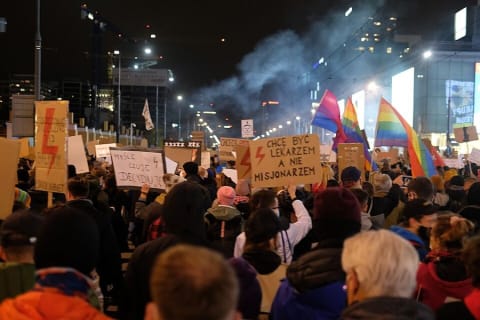
The protests are the largest in Poland since 1989, with 410
demonstrations across the country on 28 October alone and
more than 430,000 people out that day on police figures, and
about 100,000 in Warsaw at the peak on 30 October
|
Score 2 of 3
-
2 September 2021: a state of emergency is declared in 183
places along the Belarusian border, shutting journalists,
doctors and aid organisations out of a strip of the country.
When it lapses at the end of November, regulations keep the
ban on entering the border strip in place until 30 June 2022
-
People are pushed back over the border into the forest, and
bodies keep being found there
-
Reporters are charged with breaching the emergency for
working inside the zone, and on 18 January 2022 the Supreme
Court acquits them, calling the ban disproportionate and
unconstitutional. This is the darkest cell in the row, and
it is at the border rather than against opponents
|
Score 1 of 3
-
The exclusion zone is gone: the last ban on entering the
border strip expired on 30 June 2022, the day the wall was
finished, and no new one is imposed until June 2024. The
pushbacks go on behind the wall, and deaths in the forest go
on being recorded, on 7 January, 12 February, 23 October and
4 November
-
No outcome in the campaign is settled by force, and the
violence that does happen stays isolated: a stoned campaign
bus, a pushed candidate, defaced posters, anonymous
threats. The
parties campaign, the count is honest, and the losing side
leaves office
|
Score 1 of 3
-
13 June 2024: the new government brings back a ban on entering a strip along the Belarusian border, about 78 kilometres long and mostly 200 metres deep
-
From 27 March 2025, under a law the president signed that month, people crossing from Belarus can no longer claim asylum at that border, with exceptions for unaccompanied children, pregnant women and a few others. The United Nations refugee agency and Poland's own human rights commissioner call it a breach of European and international law. It is still in force in September 2026
-
As in the column before, this row is about the border rather than about political opponents
|
 Indicator 4
Readiness to curtail civil liberties and the press |
Score 1 of 3
-
30 December: a media law puts the appointment of the boards
of public television and radio in the hands of the treasury
minister and ends the terms of the boards then sitting. The
president signs it on 7 January 2016 and the boards go the
day after
-
A civil service law passed the same day removes open
competition for senior posts in the administration
-
The private newspapers, the largest news sites and the
biggest commercial broadcaster are not touched, and they
stay the main source of news for the whole of the period
covered here
|
Score 2 of 3
-
By May, 141 journalists at public television and radio have
gone since the election, dismissed, pushed out or moved to
lesser jobs, by the count of the Journalists' Society,
Towarzystwo Dziennikarskie
-
22 June: a National Media Council is created, moving the
appointments from the treasury minister to a five member
council, three elected by the Sejm and two named by the
president from opposition nominations
-
A surveillance law in January lets the police take
telephone, postal and internet data with no court order and
only a six monthly report to a judge afterwards, and the
anti terrorism law of 10 June lets the head of the security
service watch a person who is not a Polish citizen for up to
three months without asking a court at all
|
Score 2 of 3
-
December: the broadcasting council fines the largest private
news channel 1.48 million złoty over its coverage of the
parliamentary protests of December 2016. The fine is
withdrawn a month later
-
15 September: a National Freedom Institute is created by
statute, in force from 28 October, under the prime
minister's office, to hand out the government's grant money
for civic organisations
-
State advertising is steered towards friendly titles. The
critical papers keep publishing and keep selling
|
Score 2 of 3
-
20 December 2019: the Sejm passes what everyone calls the
muzzle law, making it a disciplinary offence for a judge to
question the appointment of another judge. The Senate
rejects it outright on 17 January 2020, the Sejm overrides
the Senate on 23 January, the president signs on 4 February
and it comes into force on 14 February
-
Judges who send questions to the Court of Justice, or who
ask to see the lists of names behind the new judicial
council, are put through disciplinary proceedings
-
11 January 2020: judges from across Europe walk through
Warsaw in their robes against the bill
|
Score 2 of 3
-
December: the state controlled oil company agrees to buy
Polska Press, about twenty regional dailies, roughly 120
local weeklies and some 500 websites. The sale completes on
1 March 2021, and by the end of April three regional
editors in chief have been dismissed
-
22 October: the Constitutional Tribunal removes the ground
on which almost all lawful abortions in Poland were carried
out. The judgment goes unpublished for three months
-
Observers find the public broadcaster failed its legal duty
of balance in the presidential election and acted as a
campaign vehicle for the incumbent
|
Score 2 of 3
-
A bill that would force the American owner of the largest
private news channel to sell passes the Sejm on 11 August
2021 by 228 to 216. The Senate, held by the opposition,
rejects it on 9 September; the Sejm overrides that rejection
on 17 December; the president vetoes it on 27 December
-
The broadcasting council had sat on that channel's licence
renewal for eighteen months and granted it in late September
2021, days before the old one ran out
-
10 February 2021: private television channels, newspapers,
radio stations and news sites go dark for a day against a
proposed advertising levy, which does not come back in that
form
|
Score 2 of 3
-
Observers from the OSCE find the public broadcaster's
election coverage distorted and openly partisan, and the
government's information campaigns hard to tell apart from
the party's
-
State advertising and state company sponsorship have gone
to friendly titles, on the observers' account since 2019. The largest
independent newsrooms in the country are still the largest
-
In December the incoming government removes the boards of
public television, radio and the news agency using company
law rather than the media law, and lawyers who spent eight
years defending those rules divide over whether this was
lawful
|
Score 1 of 3
-
The public broadcasters taken over in December 2023 stay in dispute. Reporters Without Borders finds they struggled to rebuild their credibility and are caught in a political battle between the government's reforms and the former ruling party's obstruction
-
In the 2026 World Press Freedom Index Poland ranks 27th of 180. The same organisation still lists restrictions on reporting along the Belarusian border, the broadcasting regulator's attempts to influence editorial content, and criminal penalties for insulting state institutions
|
 Indicator 5
Who could still hold them to account
Added, not from the book |
Score 1 of 3
-
The Constitutional Tribunal is the first target and is still
working: on 3 December it rules that three of the October
judges were lawfully chosen and that the president must
swear them in
-
16 November: the president pardons the incoming minister
for the special services, the former head of the anti
corruption bureau, convicted at first instance of abuse of
power,
before his appeal has been heard. The Supreme Court rules in
2017 that a pardon given before a final conviction has no
effect
-
Everything else is standing: an independent Supreme Court,
an ombudsman who took office in September and was elected
by the outgoing Sejm in July, a private press that
outsells the state's, sixteen regional governments, and the
European Union
|
Score 2 of 3
-
December: the Tribunal's president reaches the end of his
term and a judge appointed by the new majority takes the
chair after a meeting at which six judges vote, five of them
for her, in an assembly of fifteen. From then on the court
stops being an obstacle
-
March: the office of prosecutor general is folded back into
the justice ministry, so one politician now directs every
prosecution in the country and can take over any case
-
13 January: the European Commission opens its rule of law
procedure, the first time it has ever been used. 3 October:
the Black Monday strike empties workplaces in more than a
hundred towns and the abortion bill is dropped three days
later
|
Score 2 of 3
-
24 July: the president refuses two of the three bills after
a week of candles outside the courts. The gatekeeper does
occasionally say no, which is worth noticing, and so is how
seldom
-
20 December: the European Commission asks the Council to
find a clear risk of a serious breach of the rule of law in
Poland. The Council holds hearings and never votes on it
-
The Sejm, the Senate, the presidency, the Constitutional
Tribunal and the prosecution service are now all held by one
side. What is
left is the street, the private press, the local
governments, the courts abroad and the next election
|
Score 2 of 3
-
October 2018: the Court of Justice orders the Supreme Court
retirements suspended and Poland complies. The judges are
back at their desks within weeks. It is the clearest
reversal of the whole period, and it comes from outside the
country
-
October and November 2018: the opposition takes Warsaw,
Poznań and Łódź in the first round on 21 October and holds
Kraków and Gdańsk in the run off on 4 November. The
governing party comes first in the regional assemblies with
34.1 percent and 254 of the 552 seats
-
October 2019: the party wins the Sejm again with 43.6
percent, its best share since 1989, and loses the Senate.
The governing camp takes 48 of the 100 seats, and on 12
November the opposition elects the Speaker 51 votes to 48.
Every bill now has to go through a chamber it does not
control, which can delay it for thirty days and force a
second Sejm vote, but cannot stop it
|
Score 2 of 3
-
12 July: the president is re elected by two points. The
tilt described in the rows above was worth a great deal, and
it was not worth more than two points
-
On 3 August the election is declared valid by the Supreme
Court's new Chamber of Extraordinary Control and Public
Affairs, a chamber made up entirely of judges appointed on
the recommendation of the new council. Of 5,847 voters'
protests it upholds 93, holding that none of them changed
the result
-
From 22 October the largest protests since 1989 hold the
streets for weeks. The government delays publishing the
abortion judgment for three months but does not withdraw it
|
Score 2 of 3
-
27 October 2021: the Court of Justice orders Poland to pay
a million euros a day until it suspends the disciplinary
regime it was told to suspend in July, including the
Disciplinary Chamber's power over judges. The chamber is
abolished in July 2022 and replaced. Money from outside is
the only lever that produces a new law here, and the money
itself still does not arrive
-
15 July 2021: the ombudsman leaves office after the
Constitutional Tribunal strikes down the provision that let
him stay on until a successor was agreed. Parliament had
failed to agree one for ten months
-
Poland's recovery money stays unpaid, the opposition holds
the Senate and the big cities, and the courts in Luxembourg
and Strasbourg keep ruling
|
Score 1 of 3
-
15 October: 74.4 percent turn out, more than in any Polish
election since 1989, and the governing coalition loses its
majority. Not a court, not Brussels, not the street. Voters
-
The handover takes two months. The president first asks the
outgoing prime minister to form a government; he loses the
confidence vote on 11 December, and the new prime minister
is sworn in on 13 December
-
What the losing side keeps: the presidency and its veto,
Duda until August 2025 and then Karol Nawrocki, the
candidate it backs, who wins the run off on 1 June 2025
with 50.9 percent and takes office on 6 August, and a
Constitutional Tribunal it appointed. Undoing the capture turns out to be harder
than doing it was
|
Score 0 of 3
-
1 June 2025: voters give the presidency to the opposition's candidate, and from 6 August his veto blocks the government. On 19 February 2026 he vetoes the bill that would have let judges again elect most of the judicial council, his 26th veto since taking office
-
15 May 2026: the Sejm uses the 2017 law the veto left in place to elect fifteen new judicial members of that council, thirteen of them picked first in a vote among judges. Law and Justice challenges the procedure before the Constitutional Tribunal
-
6 May 2026: the European Court of Human Rights orders Poland not to hinder the four blocked Tribunal judges from taking up their duties. On 12 May the Tribunal rules that the president is not obliged to swear judges in. As of early September the four have still not been admitted, and in late July judges appointed under Law and Justice still made up a majority of the court
|